

Zillow Estimates Ultimate Guide: What Is It & How Accurate Is It?
The Zestimate is Zillow’s automated home valuation tool. It uses public data, MLS records, and proprietary algorithms to instantly estimate a property’s market value, with no agent or signup required. It’s one of the most widely used pricing tools in real estate, but also one of the most understood, which is why I’ve had countless clients ask, “How accurate is a Zestimate?”
In my experience, Zestimates can get pretty close, but they are definitely not 100% accurate. I’ve seen them come in both above and below what a home actually sells for. That said, they can be a great starting point for conversations. As agents, we can use them to set expectations, guide pricing discussions, and educate buyers and sellers on what really matters, home value beyond what an algorithm can see.
Key Takeaways:
- Zillow uses proprietary technology to estimate a home’s market value.
- The nationwide median error rate for on-market homes is 1.94%, and that of off-market homes is 7.06%.
- On-market data is based on listing price, description, comparable homes in the area, and days on the market.
- Tax assessments, prior sales, and other publicly available records determine off-market data.
How Zestimate works and gets its data
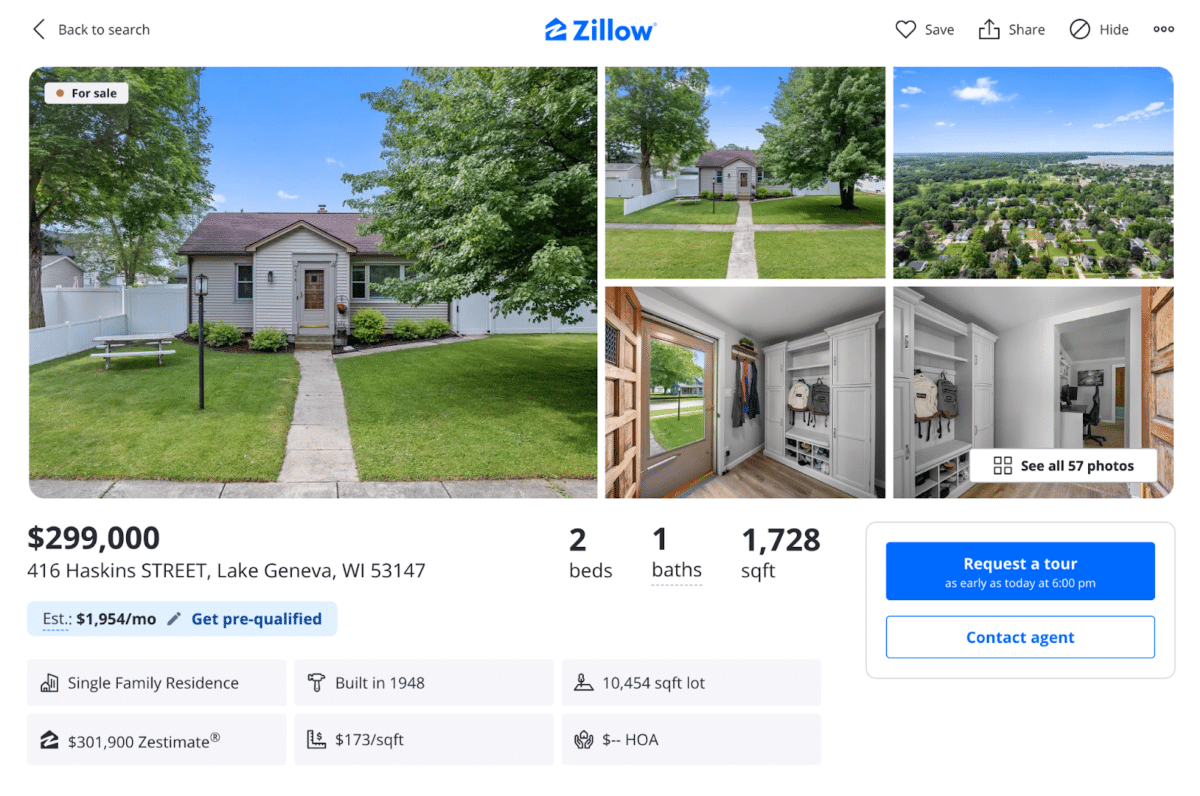
The Zestimate is a home valuation based on a sophisticated algorithm that considers many factors and data points and is delivered in real-time for both on- and off-market properties. However, it’s not the same as a professional appraisal conducted in person by a licensed expert.
In-person evaluations take into account things an algorithm can’t, such as the home’s actual condition, upgrades, layout quirks, or neighborhood appeal. Naturally, those tend to be more accurate.
How is a Zestimate calculated?
A property’s Zestimate is calculated by complex software using an “automated valuation model” that analyzes data points collected from users, public records, and multiple listing services. According to Zillow, here’s what goes into that equation:
- Home features: Number of bedrooms and bathrooms, garage size, and other key attributes
- Physical characteristics: Square footage, lot size, home type, year built, and more
- Tax assessments and prior sales: Property tax records and transaction history
- Comparable sales: Recent sales of similar homes in the area
- MLS data: Including listing price, photos, listing descriptions, and days on market (for active listings)
- User-submitted information: Such as reported upgrades or renovations
- Public data: Including county records and permits
- Market trends: Seasonal and geographic pricing shifts
Zillow updates the Zestimate daily for millions of homes, and the model is constantly refined to improve accuracy. For example, listing price wasn’t always a factor, but now it’s a key data point for on-market homes. Additionally, not all MLSs participate in Zillow’s massive data collection. This results in a much more limited data set, further skewing a Zestimate, so understanding your MLS’s relationship with Zillow is also important.
Variations to consider
- On-market: Zestimates are based on listing price, description, comparable homes in the area, and days on the market.
- Off-market: Zestimates are determined by tax assessments, prior sales, and other publicly available records.
- Geographical: State-by-state data varies in accuracy.
Planned communities: They tend to have more accurate Zestimates because the properties are much more homogeneous, making it easier to calculate accurate comps.
How accurate are Zillow Zestimates?
There is often a debate about the accuracy of the Zillow Zestimate, and we’ve all seen the jokes. But as much as some real estate agents claim the Zestimate is completely inaccurate, it’s not that cut-and-dry.
According to Zillow, there is a method to the madness regarding the Zestimate, which is a “nationwide median error rate.” For on-market homes, the error rate is 1.94%, and for off-market homes, it’s at 7.06%. The table below illustrates how close the Zestimate comes to actual sale prices using hypothetical home prices ($200K, $500K, $1M) to show what 5%, 10%, and 20% margins look like in dollar terms.
| *Data compiled from Zillow Zestimates nationwide median data (March 2025) | |||

Today, the vast majority of Zestimates fall within 10% of the sale price, and only 1% of homes are off by more than 20%. Still, when you’re buying or selling a home, even a 5% swing can mean tens of thousands of dollars, so it’s smart to treat the Zestimate as a ballpark estimate, not a final answer.
Why Zestimates isn’t 100% accurate
Zestimate accuracy can fluctuate depending on the data Zillow has access to. The listings on Zillow get updated when information is publicly available. So, for instance, if a homeowner renovates but those changes aren’t reflected in public records, the Zestimate may undervalue the property. On the other hand, homes listed on the MLS usually have more complete data, leading to more accurate estimates.
In other words, the Zestimate is best used as a reference point, not a final valuation! Where Zillow shines is in the on-market Zestimates, which are based on the list price data and are far more accurate than the off-market Zestimates.
Agent Tip: Knowing how to do a comparative market analysis (CMA) is key to delivering accurate pricing and earning client trust. While a Zestimate can serve as a helpful starting point, a well-prepared CMA offers a clearer, more personalized view of a home’s true market value, and is often why a client chooses to work with a qualified agent.
Strategies for talking to clients about a Zestimate
The Zestimate has been around since 2006 and has become a familiar tool for buyers and sellers alike. Most clients now understand it’s not a final word on value, but questions like “Is Zillow accurate?” still come up often.
As a real estate professional, it’s important to be ready with clear, confident answers. Use the Zestimate as a conversation starter, then guide clients toward a deeper understanding of what really determines home value.

Sellers typically already have a perception of what they think their home is worth, often due to the Zestimate, so don’t avoid talking about it. Add a section to your listing appointment checklist that touches on the Zestimate, and use that time to explain it further.
Strategy 1: Use your data
When conducting your listing presentation, this is your chance to show why you are confident in your listing price. Walk the seller through your customized CMA and compare it to the Zestimate to help give the seller a complete picture of accurate pricing. This is a good time to explain how a Zestimate is calculated and why variances exist.
Pro tip: If you are getting a lot of pushback from the seller because their Zestimate is different from your suggested list price, offer to test the market with the Zestimate price as a pocket listing for a specific period of time.
Strategy 2: Apply your local expertise
You know your local community better than Zillow does. Use this expertise to illustrate how your price considers new zoning, a great new donut shop coming in around the corner, whether you’ll need flood insurance, or that buyers paid more for the neighbor’s house because it had a brand-new HVAC system.
You have the advantage of proximity. Remind your clients that when making giant financial life decisions, it’s OK to back away from a computer and rely on an actual human being.
Strategy 3: Show proof of the inaccuracies
To paint a full picture, it’s important to acknowledge and discuss the potential inaccuracies that can come with the Zestimate. Our clients hire us to help them sell their homes for the highest and best price in the fastest timeframe possible. Pull some examples of Zestimate inaccuracies and explain why that can happen. Remind your clients that a home is only worth what a buyer is willing to pay and that sold homes reflect that accurately.
Strategy 4: Practice with a script
Feeling comfortable having difficult conversations with clients comes with time and experience. If you’re unsure how to approach a discussion about the Zestimate, try this script.
I know you don’t want to undervalue your home, and online estimates, like Zestimates, can be attractive. But here’s the thing: those estimates don’t always reflect the local market or take into account your home’s unique value, and they can be misleading. My CMA is based on in-depth research of the local area, current market trends, and years of local expertise. It’s designed to help you price your home strategically so you can sell quickly and for the best possible price.
I know it’s hard to hear that your home might not match an online estimate, but my goal is to be your advocate and help you get the best outcome. I’m not trying to undervalue your home, but I want to make sure it’s priced right for this market.
Let’s review my CMA together and discuss a pricing strategy that positions your home for success. I’m confident we can agree on a price you’re comfortable with and that attracts serious buyers. Remember, the longer a home sits on the market, the harder it becomes to sell. Let’s work together to price it right from the start and get you moving forward.
How agents use Zestimate strategically
Now that you understand what a Zestimate is, let’s discuss how you can use them as an agent to benefit your business.
- Pre-listing strategy: Before attending any listing appointment, I checked the home’s Zestimate. It’s common for a seller to check their Zestimate and latch onto that price. It’s important to know whether your evaluation matches the Zestimate and to prepare for objections or questions.
- Listing appointment positioning: During my listing presentations, if I believed a seller had peaked at their Zestimate, I would start my pricing conversation with “Let’s talk about the Zestimate you may have seen”. I would lead with the number they most likely saw and reframe the conversation on why that estimate is either correct or needs to be tweaked. This allows me to preempt objections and set expectations quickly.
- Prospecting: One tactic I used often when prospecting for listings was leveraging Zestimates. I’d print out a property’s Zestimate and include it in a mailer along with my business card, a sample of my marketing, and a simple question: “Do you believe this price?” This approach consistently opened the door to conversations, as homeowners would reach out, whether they agreed or disagreed, giving me the opportunity to provide my own CMA and position myself as the local expert.
- Price reduction conversations: Zestimates can be a helpful tool when discussing reducing a listing price. They provide a third-party reference point that can reinforce your pricing strategy and help validate your recommendation. Since buyers often see the Zestimate when browsing a listing, it can also influence their perception of value. Using this as part of your conversation can make it easier to guide sellers toward a price adjustment by showing how the home is being viewed in the market.
- Content angle: Looking for something to post on social media? Post a video comparing Zestimates vs what homes actually sell for. This type of content is not only interesting and highly shareable, but it also helps position you as the local expert.
Frequently asked questions (FAQs)
Is Zestimate or Redfin more accurate?

There are conflicting answers online as to whether Zillow or Redfin has the more accurate home valuations. However, Redfin has reported a median error rate of 1.93% for on-market homes, making it ever-so-slightly more accurate than the Zillow Zestimate.
Can a seller change the Zestimate?
Yes, if a homeowner would like to influence the price shown on Zillow, they can do so by editing their home facts. Fixing any incorrect or incomplete information will help get the price as accurate as possible. Information such as architectural style, roof type, heat source, building amenities, and more can also be added.
What is the difference between a Zestimate and an appraisal?
A Zestimate is an automated estimate based on public data and algorithms. An appraisal is a formal valuation by a licensed professional who inspects the home in person. Zestimates are estimates, while appraisals tend to deliver a more accurate valuation figure.
Your take
While many agents don’t love battling the Zestimate, the reality is your clients are looking at it whether you bring it up or not. In my experience, the agents who win aren’t the ones who dismiss it; they’re the ones who know how to use it. The Zestimate can be a powerful conversation starter, a way to demonstrate your expertise with a CMA, and even a tool to guide tougher discussions, such as pricing and reductions. When used correctly, it doesn’t weaken your position; it strengthens your ability to educate, build trust, and ultimately grow your real estate business.
The post Zillow Estimates Ultimate Guide: What Is It & How Accurate Is It? appeared first on The Close.